
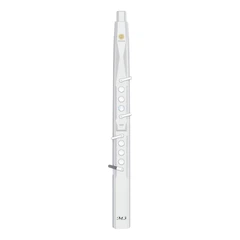


The circuit structure inside the electric wind instrument /electronic-wind-instrument/electric-saxophone-ewi.htmlmainly consists of the following parts:
1. **Sensor part**:
- **Pressure sensor**: used to detect information such as the intensity of blowing and the strength of biting. When the performer blows into the mouthpiece, the airflow will change the structure inside the pressure sensor, thereby generating a corresponding electrical signal. The strength of this electrical signal will change according to the strength of the blowing, and it is one of the important parameters for controlling the volume and timbre changes. For example, when the blowing force is strong, the electrical signal output by the pressure sensor is strong, and the volume of the sound emitted by the electric blowpipe is loud; conversely, the volume is small.
- **Key sensor**: There are multiple playing keys distributed on the electric blowpipe, and the key sensors are connected to these keys. When the performer presses different keys, the key sensors will convert the key movements into electrical signals, which represent different pitch information. Through the combination of different keys, the performer can play a variety of different scales and melodies.
2. **Controller**:
- **Signal processing**: The controller is the core part of the electric blowpipe circuit. It receives electrical signals from the pressure sensor and the key sensor and processes these signals. For example, filtering the signal to remove noise and interference to make the signal more stable and accurate; amplifying or attenuating the signal to adjust the volume; modulating the signal to change the frequency, phase and other parameters of the signal to achieve a change in timbre.
- **Logic control**: The controller is also responsible for controlling various functions of the electric blowpipe according to the performer's operation and preset parameters. For example, controlling the switching of timbre, the generation of vibrato, the change of octave, etc. It outputs corresponding control signals according to the received key signals and blowing signals, and drives other circuit modules to work according to the preset procedures and algorithms.
3. **Audio digital signal processor**: This part further processes the audio signal processed by the controller. It can adjust and optimize the frequency response, harmonic structure, dynamic range, etc. of the sound to make the sound more realistic, rich and pleasant. For example, by adjusting the frequency response of the audio signal, certain frequency components can be enhanced or weakened to make the timbre more in line with the characteristics of different instruments.
4. **Power amplifier circuit**: The function of the power amplifier circuit is to amplify the audio signal processed by the audio digital signal processor so that it has enough power to drive the speaker or other audio output device. The performance of the power amplifier circuit directly affects the output volume and sound quality of the electric blowpipe. If the power of the power amplifier circuit is insufficient, the volume of the electric blowpipe will be low; if the distortion of the power amplifier circuit is high, the sound will be distorted and the sound quality will be affected.
5. **Storage module**: Usually storage devices such as TF memory cards are used to store the timbre data and preset parameters of various musical instruments. When the performer selects different timbres, the controller reads the corresponding timbre data from the storage module and sends it to the audio digital signal processor for processing.
6. **Power supply circuit**: Provides a stable power supply for each circuit module of the electric blowpipe. Generally speaking, the electric blowpipe can be powered by a battery or an external power adapter. The power supply circuit needs to convert the DC power of the battery or the AC power of the external power supply into DC power suitable for the operation of each circuit module, and ensure the stability of voltage and current.
The internal circuit structure of the electric blowpipe has an important influence on its timbre and performance:
1. **Influence on timbre**:
- **Variety of timbre**: The large amount of timbre data stored in the storage module, as well as the signal processing capabilities of the controller and the audio digital signal processor, enable the electric blowpipe to simulate the timbre of many different instruments. For example, the sound of various instruments such as saxophone, flute, trumpet, erhu, etc. can be simulated, enriching the choices of the performers.
- **Quality of timbre**: The performance and parameter settings of each module in the circuit will affect the quality of the timbre. For example, the algorithm and parameter settings of the audio digital signal processor will affect the fidelity and delicacy of the sound; the performance of the power amplifier circuit will affect the dynamic range and distortion of the sound. If the circuit design is reasonable and the performance is excellent, the sound produced by the electric blowpipe will be closer to the timbre of the real instrument and have better sound quality.
- **Adjustability of timbre**: Through the processing of the signal by the controller, the performer can make various adjustments to the timbre, such as changing the brightness, saturation, reverberation and other effects of the timbre, so as to achieve personalized performance. This adjustability gives the electric blowpipe greater flexibility in music creation and performance.
2. **Impact on performance**:
- **Response speed**: The response speed of the circuit determines the speed at which the electric blowpipe responds to the player's operation. If the circuit responds quickly, when the player presses a key or blows, the electric blowpipe can quickly make the corresponding sound without delay or jamming, thus ensuring the smoothness of the performance.
- **Stability**: Stable power supply and good circuit design can ensure the stability of the electric blowpipe. During the performance, there will be no sound interruption, distortion, etc. due to power fluctuations or circuit failures, which improves the reliability and service life of the electric blowpipe.
- **Compatibility**: The circuit structure of the electric blowpipe will also affect its compatibility with other devices. For example, some electric blowpipes have MIDI interfaces or Bluetooth functions, which can connect and communicate with computers, audio equipment and other devices. The design of the circuit needs to ensure the normal operation of these interfaces in order to achieve seamless connection and data transmission with other devices.
/electronic-wind-instrument/electric-saxophone-ewi.html


