

Software for MIDI programming of electronic wind instruments should have the following features:
1. MIDI Mapping and Customization
Flexible Key and Controller Mapping: It should allow users to map the keys, buttons, and other controllers on the electronic wind instrument to different MIDI messages. For example, the fingering keys on the instrument can be mapped to specific note - on and note - off MIDI events, and the breath controller can be mapped to MIDI continuous controllers like modulation or volume.
User - Definable Presets: The ability to create and save custom MIDI mapping presets is crucial. This enables musicians to quickly switch between different setups depending on the musical piece they are playing or the overall performance requirements.
2. Sound and Instrument Library
Wide Range of Instrument Sounds: It should offer a comprehensive library of instrument sounds that can be triggered via MIDI. This includes not only traditional wind instruments like saxophones, flutes, and clarinets but also other orchestral instruments such as strings, brass, and percussion.
Sound Editing and Manipulation: The software should provide tools for editing the characteristics of the sounds, such as adjusting the attack, decay, sustain, and release (ADSR) of a sound, changing the timbre, and adding effects like reverb, delay, or chorus.
3. Performance - Related Features
Expression and Dynamics Handling: It must accurately translate the player's performance nuances such as breath pressure (for volume control) and pitch bends into MIDI expressions. This allows for a more natural and expressive musical performance.
Articulation and Phrasing: Support for different articulations like staccato, legato, and slur should be included. The software can interpret the player's fingering and breathing patterns to generate appropriate MIDI messages for these articulations, enhancing the musical phrasing.
4. Sequencing and Composition Tools
MIDI Sequencing: The ability to record, edit, and play back MIDI sequences is essential. Musicians can use this to build complex musical arrangements by layering different instrument parts and adjusting their timing and pitch.
Notation and Score Generation: Some software may offer the ability to generate musical notation from the MIDI data, which is useful for composers and musicians who are more familiar with reading and writing sheet music.
5. Connectivity and Compatibility
Hardware Connectivity: It should be able to connect seamlessly with the electronic wind instrument, either via USB, MIDI ports, or wireless connections like Bluetooth. Additionally, it may support connections with other MIDI - enabled devices such as keyboards, drum pads, or external sound modules.
Software Compatibility: Compatibility with popular digital audio workstations (DAWs) and music production software is important. This allows for easy integration of the electronic wind instrument into existing music production workflows.
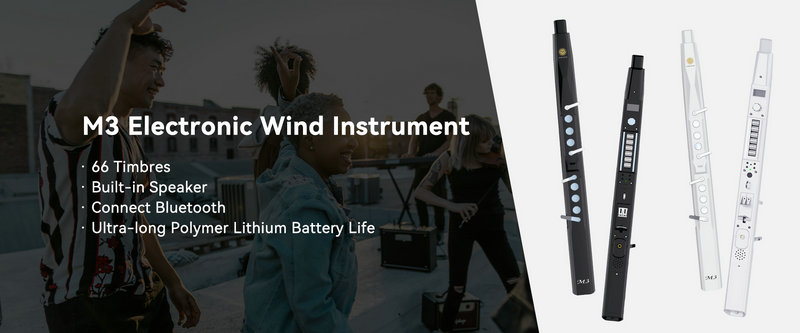
SUNRISE MELODY M3 Electronic Wind Instrument - The best-selling Electronic Wind Instrument
. 66 Timbres
. Built-in Speaker
. Connect Bluetooth
. Ultra-long Polymer Lithium Battery Life