

Cracked or Broken Casings
Cause: EWIs can be damaged due to accidental drops, impacts during transportation, or rough handling. The casing, which is usually made of plastic or a composite material, may crack or break as a result.
Fix:
For minor cracks, a two - part epoxy or a specialized plastic adhesive can be used to bond the cracked parts. It's important to clean the surfaces thoroughly before applying the adhesive to ensure a good bond.
If the casing is broken into pieces, it may be possible to replace the entire casing. Some manufacturers offer replacement casings, and these can usually be installed by removing the internal components (carefully) and fitting them into the new casing. In some cases, it may require some technical skills to disassemble and reassemble the instrument, such as dealing with the wiring and connectors that attach the internal electronics to the keys and sensors.
Damaged Keys or Buttons
Cause: Over time, the keys or buttons on an EWI can become damaged. This can happen due to repeated use, excessive force during playing, or debris getting stuck in the key mechanisms. The keys may become bent, loose, or stuck.
Fix:
If a key is bent, it can often be carefully straightened using pliers. However, this must be done with great care to avoid further damage to the key or the underlying mechanism.
Loose keys can be tightened. Some keys have screws or small fasteners that can be adjusted to secure the key in place. In other cases, the problem may be due to a worn - out spring or a damaged hinge. Springs can usually be replaced if they are accessible. Hinges may need to be repaired or replaced if they are damaged. This may involve disassembling the key mechanism to some extent, and it's crucial to keep track of the parts and their correct assembly order.
Stuck keys are often caused by dirt or debris. The key mechanism can be cleaned using a small brush (such as a soft - bristled paintbrush) to remove any particles. A small amount of lubricant (such as a silicone - based lubricant designed for electronics) can also be applied to the key mechanism to ensure smooth movement.
Broken or Damaged Connectors
Cause: The connectors on an EWI, such as the MIDI output, audio output jacks, or power connectors, can break due to repeated plugging and unplugging, being yanked, or exposure to moisture.
Fix:
If a connector is loose, it may be possible to tighten it. Some connectors have a small nut or a locking mechanism that can be adjusted to secure the connection.
For a physically broken connector, it may need to be replaced. If the connector is soldered to the circuit board, this requires soldering skills and the appropriate tools. The damaged connector can be carefully desoldered from the board and a new one soldered in its place. In cases where the connector is part of a cable (such as a power cable or a MIDI cable), the cable may need to be replaced entirely.
Sensor Damage
Cause: The breath and finger sensors on an EWI can be damaged. The breath sensor may be damaged by moisture, excessive force, or debris. Finger sensors can be damaged due to impacts or electrical faults.
Fix:
For a damaged breath sensor, if it's a simple issue like moisture, allowing the instrument to dry completely may solve the problem. Some sensors can be cleaned using a soft, dry cloth or a mild electronics cleaner. If the sensor is physically damaged, it may need to be replaced.
Damaged finger sensors may require replacement as well. This usually involves opening the instrument to access the sensor and disconnecting and reconnecting the appropriate wires. In some cases, it may be possible to repair a loose connection or a minor electrical fault in the sensor circuitry, but this requires a good understanding of electronics and the specific sensor design.
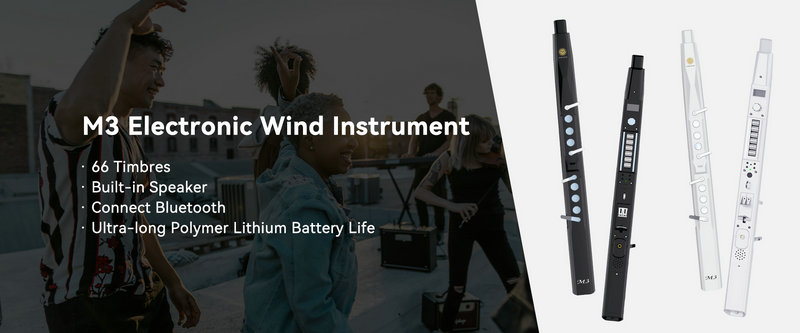
SUNRISE MELODY M3 Electronic Wind Instrument - The best-selling Electronic Wind Instrument
. 66 Timbres
. Built-in Speaker
. Connect Bluetooth
. Ultra-long Polymer Lithium Battery Life