
Repairing common EWI damages may require the following tools:
1. For Casing and Physical Structure Repairs
Screwdrivers: A set of precision screwdrivers is essential. Many EWIs have small screws that hold the casing together or attach components to the body. Phillips and flat - head screwdrivers in various sizes are needed to access the internal parts for repairs such as replacing a damaged circuit board or fixing a loose key mechanism.
Pliers: Needle - nose pliers are useful for handling small parts and wires. They can be used to bend or straighten keys if they are bent. When working with connectors or wires, they can help in gripping and manipulating small components.
Epoxy or Adhesive: As mentioned earlier, for repairing cracked casings, a two - part epoxy or a specialized plastic - friendly adhesive is necessary. These adhesives come with applicators such as syringes or small spatulas to ensure accurate application.
2. For Connector and Wiring Repairs
Soldering Iron and Solder: If a connector needs to be replaced on the circuit board or there is a loose wire connection, a soldering iron and solder are required. A soldering iron with a fine tip (around 15 - 30 watts for electronics work) is suitable for working with the delicate components of an EWI. The solder should be of a type suitable for electronics, such as a rosin - core solder with a small diameter (e.g., 0.6 - 0.8 mm).
Wire Cutters and Strippers: When dealing with damaged wires or installing new connectors, wire cutters and strippers are needed. The wire cutters should be able to cut through the thin wires used in the EWI without crushing them. The strippers are used to carefully remove the insulation from the wire ends to prepare them for soldering or connecting to new components.
3. For Sensor and Internal Component Repairs
Multimeter: A multimeter is a valuable tool for diagnosing electrical problems. It can be used to test the continuity of wires, check the resistance of sensors, and measure the voltage of the power supply. This helps in identifying faulty components such as a damaged sensor or a short - circuit in the circuit board.
Cleaning Tools: To clean sensors, keys, and other internal components, a small, soft - bristled brush (like a paintbrush or a specialized electronics brush) is useful. Additionally, lint - free cloths and a small amount of electronics - cleaner (such as isopropyl alcohol - based cleaners) can be used to remove dirt and debris without damaging the components.
Calibration Tools (if available): Some EWIs come with software or built - in calibration functions for sensors. In such cases, the necessary software (usually provided by the manufacturer) and a computer with the appropriate connection cable (e.g., USB) are needed to calibrate the sensors and adjust their sensitivity.
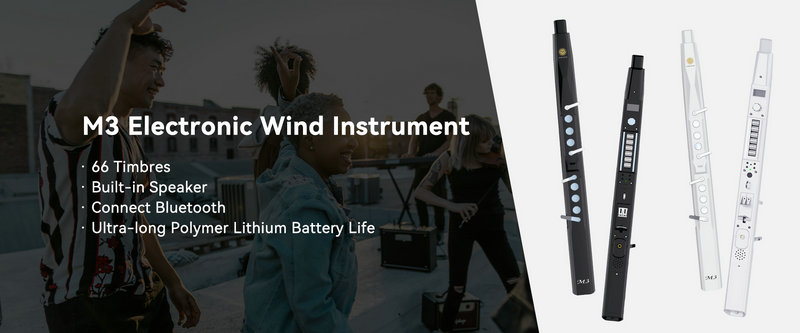
SUNRISE MELODY M3 Electronic Wind Instrument - The best-selling Electronic Wind Instrument
. 66 Timbres
. Built-in Speaker
. Connect Bluetooth
. Ultra-long Polymer Lithium Battery Life