
When an electronic wind instrument is connected to an external device, it is not inevitable that there will be some delay, but in many real - world situations, a small amount of delay can occur for the following reasons:
I. Signal Processing
Digital - to - Analog and Analog - to - Digital Conversion
When the electronic wind instrument sends a digital signal (such as MIDI) to an external device that may require analog output (like an amplifier), there are processes of digital - to - analog conversion. Similarly, if the instrument has an analog input that is converted to digital for internal processing and then sent to an external digital device, these conversions take time. Although modern converters are very fast, they still introduce a minimal amount of latency.
Buffering and Processing within Devices
Both the electronic wind instrument and the external device may have internal buffers for handling data. For example, the external device might buffer incoming MIDI data to ensure smooth processing. This buffering can introduce a slight delay as the data waits in the buffer before being processed further. Additionally, if the external device is performing complex audio processing, such as applying effects or mixing multiple signals, this processing can also contribute to a delay.
II. Communication Protocols
MIDI Protocol Limitations
If the connection between the electronic wind instrument and the external device is via MIDI, the MIDI protocol itself has some limitations in terms of data transfer speed. Although MIDI is a well - established and widely used standard, it was designed with a certain data rate in mind. In some cases, especially when a large amount of MIDI data is being sent quickly (for example, during very fast playing with many note - on and note - off messages), there can be a small delay as the MIDI data is transmitted and processed.
Wireless Connections (if applicable)
If the connection is wireless, such as via Bluetooth, there are additional factors that can cause delay. Wireless communication is subject to interference, and the data transfer rate may be affected. Bluetooth, for example, has a certain latency associated with it, and environmental factors like other wireless devices in the vicinity can further increase this latency.
However, with advancements in technology:
High - Speed Interfaces
Newer interfaces and protocols are being developed to reduce latency. For example, some devices now use USB 3.0 or higher - speed connections for MIDI and audio data transfer, which can significantly reduce the time taken for data to be transmitted compared to older interfaces like USB 2.0 or traditional MIDI ports.
Improved Signal Processing Chips
The internal chips in both electronic wind instruments and external devices are becoming more powerful and efficient. They can process data faster, reducing the time taken for buffering and processing, and thus minimizing the potential for delay.
So, while delay can occur, it is not an absolute inevitability, and manufacturers are constantly working to reduce or eliminate it.
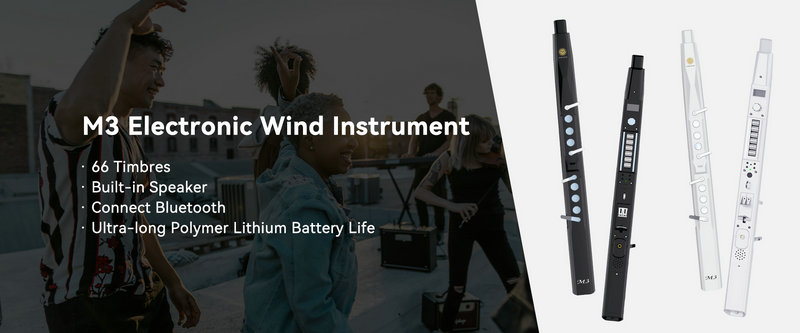
SUNRISE MELODY M3 Electronic Wind Instrument - The best-selling Electronic Wind Instrument
. 66 Timbres
. Built-in Speaker
. Connect Bluetooth
. Ultra-long Polymer Lithium Battery Life