
The signal receiver of electronic wind instruments operates in a rather intricate manner. Here is a more detailed breakdown:
Signal Reception
Wireless Mode: In the case of wireless signal transmission, which is common in many modern electronic wind instruments, the receiver is equipped with a specialized antenna system. This antenna is designed to be highly sensitive to the specific frequency range used by the instrument for communication. For example, it might be tuned to a particular radio frequency band. When the player performs on the instrument, sensors within the instrument convert the physical actions like breath pressure variations, the speed and direction of air flow, and the movements of the fingers on the keys or touchpads into electrical signals. These electrical signals are then modulated onto a carrier wave and transmitted wirelessly. The receiver's antenna captures these wireless signals. The design of the antenna and the associated radio frequency (RF) front - end circuitry ensure that the weak RF signals are received with as little interference as possible. This involves techniques such as filtering out unwanted frequencies from the surrounding environment, which could be signals from other wireless devices or background noise.
Wired Connection: In some traditional or specialized electronic wind instruments, a wired connection is used. In this setup, a cable connects the instrument directly to the receiver. The cable usually contains multiple conductors to carry different types of signals. For example, there might be separate lines for the signals related to breath control, finger actions, and other functions. The receiver has corresponding input ports to accept these wired signals. The advantage of a wired connection is its high reliability and immunity to certain types of interference that can affect wireless signals. However, it restricts the player's movement during performance.
Signal Amplification
Once the signals are received, whether through wireless or wired means, they are often very weak. The receiver incorporates amplification stages. These amplification circuits are carefully designed to boost the signal strength without introducing excessive noise or distortion. The amplification process involves using transistors or integrated amplifier chips. The gain of the amplifier is set to an appropriate level to bring the signal to a strength that can be further processed accurately. For example, if the initial received signal has a very low voltage amplitude, the amplifier might increase it by several orders of magnitude. This amplification is crucial because subsequent processing steps require signals within a certain voltage range for proper operation.
Signal Processing and Decoding
Frequency Conversion and Filtering: In some advanced receivers, especially those dealing with complex wireless communication systems, there may be a frequency conversion process. This is done to shift the received signal from the carrier frequency to a lower intermediate frequency. This conversion simplifies the subsequent processing by reducing the complexity of the signal filtering and demodulation. Additionally, during this stage, further filtering is performed to remove any remaining unwanted frequencies or noise that might have passed through the initial reception stage. High - pass, low - pass, or band - pass filters are used to ensure that only the relevant signal components are retained.
Demodulation and Decoding: The received and filtered signals then undergo demodulation. In the case of wireless transmission, if the signals were modulated using a specific modulation scheme such as amplitude modulation (AM), frequency modulation (FM), or more advanced digital modulation techniques like quadrature amplitude modulation (QAM), the demodulator in the receiver extracts the original baseband signal. For digital signals, this involves processes like demodulating the digital carrier and then decoding the digital data stream. The decoding process is highly specific to the encoding scheme used by the instrument. It might involve interpreting digital codes that represent different musical notes, playing techniques, and other performance - related information. For example, a particular binary code might be assigned to a specific note and its associated playing characteristics like staccato or legato.
Data Reconstruction and Error Correction: After decoding, the receiver may perform data reconstruction and error correction. In some cases, during the transmission process, errors can occur due to interference or other factors. Error - correction codes are used to detect and correct these errors. This ensures that the received data accurately represents the player's actions on the instrument. The reconstructed data is then in a format that can be used to generate the corresponding audio signal.
Output to External Devices or Systems
Once the signal has been fully processed and decoded, the receiver has to output it to the appropriate external devices. If the goal is to produce sound for the player or the audience, the signal is sent to an amplifier. The amplifier further increases the power of the signal to a level sufficient to drive a speaker. The amplifier's design takes into account factors such as the impedance matching with the speaker to ensure maximum power transfer and high - quality sound reproduction. In addition to speakers, the receiver may also be able to send the signal to other audio equipment such as mixers, audio interfaces for recording purposes, or to other musical instruments or devices in a larger musical setup. For example, in a live performance with multiple instruments, the electronic wind instrument's signal might be combined with those of other instruments in a mixer before being sent to the main sound system. In some cases, the receiver can also communicate with computer - based music production software, allowing the player to use the instrument to control virtual instruments or to record and edit the performance within the software environment.
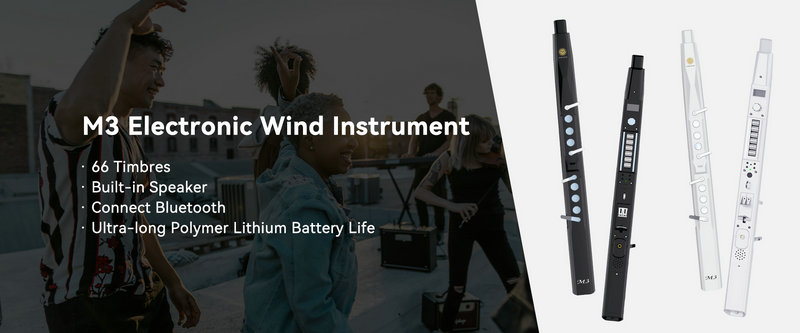
SUNRISE MELODY M3 Electronic Wind Instrument - The best-selling Electronic Wind Instrument
. 66 Timbres
. Built-in Speaker
. Connect Bluetooth
. Ultra-long Polymer Lithium Battery Life