
The timbre simulation of electronic wind instruments can be further improved in the following ways:
Advancement in sound sampling technology:
Higher-quality sampling: Use more advanced sampling equipment and techniques to capture the sound of traditional wind instruments with higher fidelity. This includes increasing the sampling rate and bit depth to capture more detailed information about the sound, such as the subtle changes in pitch, timbre, and overtones during different playing techniques. For example, when sampling a saxophone, more detailed samples can be taken at different pitches, intensities, and articulations to ensure a more accurate reproduction of the saxophone's timbre in the electronic wind instrument.
Expansion of sample libraries: Continuously expand and enrich the sample libraries of electronic wind instruments to cover a wider range of traditional wind instruments and playing styles. This can involve collaborating with professional musicians and instrument makers to obtain high-quality sound samples from a variety of rare and unique traditional wind instruments, as well as different playing techniques and expressions, such as the special timbre produced by different embouchures and breathing methods.
Improvement of sound synthesis algorithms:
More complex algorithms: Develop more complex and sophisticated sound synthesis algorithms that can better simulate the physical and acoustic characteristics of traditional wind instruments. For example, algorithms that can accurately simulate the vibration of the air column, the interaction between the instrument body and the air, and the resonance of the instrument can help to create more realistic timbres. This may involve the use of advanced mathematical models and digital signal processing techniques to simulate the complex acoustic phenomena of traditional wind instruments.
Adaptive algorithms: Implement adaptive algorithms that can adjust the sound parameters in real time according to the player's playing style and environment. For instance, the algorithm can detect the player's breathing intensity, finger pressure, and other playing behaviors, and then adjust the timbre, volume, and other parameters accordingly to achieve a more natural and responsive sound output. This requires the use of sensors and real-time data processing technology in the electronic wind instrument.
Enhancement of hardware components:
Superior sensors: Employ more sensitive and accurate sensors to capture the player's playing actions, such as breath flow, finger movements, and mouth pressure. High-quality sensors can provide more accurate input signals, which is essential for the accurate reproduction of timbre. For example, using a breath sensor with higher sensitivity can better detect the subtle changes in the player's breathing, allowing the electronic wind instrument to respond more accurately to the player's breath control and produce more realistic sound variations.
Better sound processing chips: Use more powerful sound processing chips to handle the complex sound synthesis algorithms and large amounts of sound data in real time. A high-performance sound processing chip can ensure smooth and stable sound output, reduce latency, and improve the overall performance of the electronic wind instrument. This can also enable the instrument to handle multiple sound effects and processing tasks simultaneously, such as adding reverb, chorus, and other effects to the simulated timbre to enhance its richness and authenticity.
Integration of artificial intelligence and machine learning:
Timbre learning and optimization: Apply artificial intelligence and machine learning techniques to analyze and learn the characteristics of traditional wind instrument timbres. By training the system with a large amount of sound data from traditional wind instruments, the electronic wind instrument can automatically optimize the sound synthesis parameters and algorithms to achieve more accurate timbre simulation. For example, using deep learning algorithms to learn the relationship between the playing techniques of traditional wind instruments and the resulting timbres, and then applying this knowledge to the timbre simulation of the electronic wind instrument.
Personalized timbre customization: Allow users to customize and adjust the timbre through artificial intelligence and machine learning technology. The electronic wind instrument can learn the user's playing preferences and habits over time, and then provide personalized timbre adjustment suggestions and presets. This can enable users to create their own unique timbres based on the simulated timbres of traditional wind instruments, enhancing the creativity and individuality of the instrument.
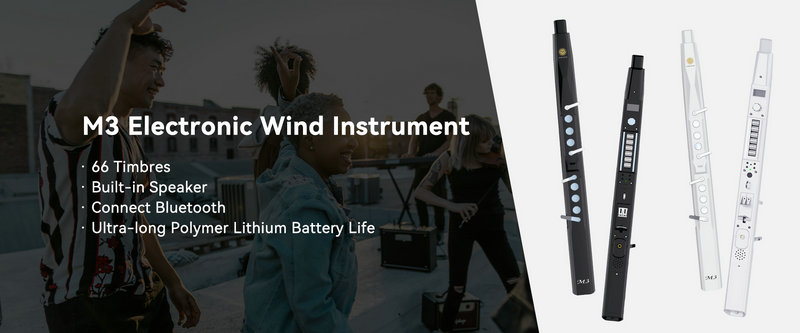
SUNRISE MELODY M3 Electronic Wind Instrument - The best-selling Electronic Wind Instrument
. 66 Timbres
. Built-in Speaker
. Connect Bluetooth
. Ultra-long Polymer Lithium Battery Life