

Artificial intelligence can be used to improve the timbre simulation of electronic wind instruments in several ways:
Audio signal analysis and feature extraction:
Detailed feature identification: AI can analyze the audio signals of traditional wind instruments in great detail. By using techniques such as short-time Fourier transform, wavelet transform, or deep learning-based methods, it can extract a wide range of features from the audio, including time-domain features like attack time, decay time, and sustain time that reflect the dynamic characteristics of the sound; frequency-domain features such as fundamental frequency, harmonic components, and spectral envelope that represent the pitch and timbre structure3.
Personalized timbre understanding: For different players and playing styles of traditional wind instruments, AI can learn and identify the unique features of their timbres. This helps in capturing the individual nuances and variations in timbre, which can then be applied to the simulation of electronic wind instruments to make the simulated timbre more personalized and realistic.
Sound synthesis and modeling:
Advanced algorithms for timbre generation: AI can utilize complex algorithms such as neural networks, especially convolutional neural networks (CNN) and recurrent neural networks (RNN), to model the relationship between the physical characteristics of traditional wind instruments and their timbres. This allows for more accurate generation of timbres in electronic wind instruments by simulating the vibration of the air column, the resonance of the instrument body, and other physical processes that contribute to the unique timbre of traditional wind instruments3.
Generation of new timbres: Through generative adversarial networks (GAN) or variational autoencoders, AI can explore the potential space of timbres and generate new and diverse timbres that are inspired by traditional wind instruments but may have unique characteristics of their own. This provides more options and creativity for the timbre simulation of electronic wind instruments, allowing users to explore and create novel sounds3.
Adaptive and real-time adjustment:
Response to playing style and environment: AI can adapt the timbre of electronic wind instruments in real time according to the player's playing style, breathing intensity, finger pressure, and other playing behaviors. By continuously analyzing the input signals from the player, the AI system can adjust the timbre parameters to match the player's intentions and create a more natural and responsive playing experience. Additionally, it can also adapt to the environmental factors such as temperature, humidity, and air pressure, which can affect the sound of traditional wind instruments, to further enhance the realism of the timbre simulation3.
Error correction and optimization: In the process of timbre simulation, AI can detect and correct errors or inaccuracies in the sound. For example, if there are deviations in the simulated timbre compared to the real timbre of traditional wind instruments, the AI system can adjust the parameters automatically to minimize the differences and improve the accuracy of the timbre simulation.
Expansion of sample libraries:
Automated sample collection and classification: AI can assist in the collection and classification of a large number of sound samples of traditional wind instruments. By using machine learning algorithms, it can automatically identify and classify different types of instruments, playing techniques, and musical styles from a vast amount of audio data, which greatly simplifies the process of building and expanding the sample library.
Sample enhancement and synthesis: Based on the existing samples, AI can enhance the quality of the samples through techniques such as noise reduction, harmonic enhancement, and dynamic range adjustment. It can also synthesize new samples by interpolating and extrapolating the existing samples, which can enrich the variety of the sample library and improve the quality of the timbre simulation.
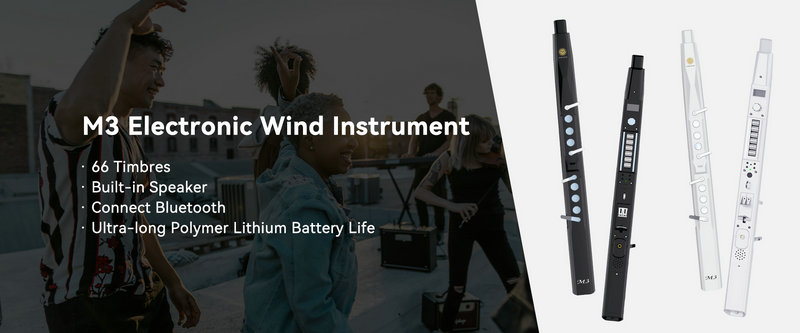
SUNRISE MELODY M3 Electronic Wind Instrument - The best-selling Electronic Wind Instrument
. 66 Timbres
. Built-in Speaker
. Connect Bluetooth
. Ultra-long Polymer Lithium Battery Life