
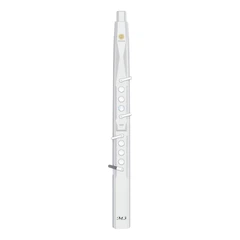


Digital wind instruments have brought a new dimension to the world of music, combining traditional playing techniques with advanced digital technology. To master these instruments effectively, a solid understanding of music theory is essential. In this article, we will provide a detailed introduction to the music theory knowledge required for learning digital wind instruments.
I. Notes and Pitch
The foundation of music theory begins with understanding notes and pitch. In digital wind instruments, as in all musical instruments, different pitches are produced by playing different keys or buttons. Here are the key concepts to understand:
Pitch
Pitch refers to the highness or lowness of a sound. It is determined by the frequency of the sound wave. The higher the frequency, the higher the pitch.
In music, we use a system of notes to represent different pitches. The most common system is the Western musical scale, which consists of seven main notes (A, B, C, D, E, F, and G) and their variations.
Notes
Notes are symbols used to represent specific pitches. Each note has a name and a corresponding pitch. For example, the note "C" represents a specific pitch.
Notes can be written on a musical staff, which is a set of five horizontal lines and four spaces. The position of a note on the staff indicates its pitch.
Accidentals
Accidentals are symbols used to modify the pitch of a note. The most common accidentals are sharps (#), flats (b), and naturals (♮). A sharp raises the pitch of a note by a half step, a flat lowers the pitch by a half step, and a natural cancels a previous sharp or flat.
II. Scales and Keys
Scales and keys are fundamental concepts in music theory that are essential for playing digital wind instruments. Here's what you need to know:
Scales
A scale is a series of notes arranged in a specific order. The most common scales in Western music are major and minor scales.
Major scales have a bright and happy sound, while minor scales have a more melancholic or sad sound. Each scale has a specific pattern of whole steps and half steps.
Scales can be played in different octaves, which are ranges of pitches. The higher the octave, the higher the pitch.
Keys
A key is a set of pitches based on a specific scale. For example, the key of C major is based on the C major scale.
Keys are identified by the name of the tonic note, which is the first note of the scale. In the key of C major, the tonic note is C.
Different keys have different characteristics and moods. Some keys are more suitable for certain types of music or emotions.
III. Rhythm and Meter
Rhythm and meter are crucial aspects of music that determine the timing and flow of a piece. Here's what you should understand:
Rhythm
Rhythm refers to the pattern of long and short sounds in music. It is created by the combination of notes of different durations.
The most common note durations are whole notes, half notes, quarter notes, eighth notes, and sixteenth notes. Each note duration has a specific time value.
Rhythm can also be created by rests, which are periods of silence in music. Rests have the same durations as notes.
Meter
Meter is the organization of rhythm into regular patterns of beats. The most common meters are duple (two beats per measure), triple (three beats per measure), and quadruple (four beats per measure).
The first beat of each measure is usually the strongest beat, called the downbeat. The other beats are weaker and create a sense of rhythm and pulse.
IV. Harmony and Chords
Harmony and chords add depth and richness to music. Here's an overview of these concepts:
Harmony
Harmony refers to the combination of different pitches played simultaneously. It creates a sense of consonance (pleasant sounds) and dissonance (unpleasant sounds).
Harmony can be created by playing chords, which are groups of three or more notes played together. Chords can be major, minor, augmented, or diminished, depending on the intervals between the notes.
Chords
Chords are built on scales. For example, a major chord is built on the first, third, and fifth notes of a major scale.
Chords can be played in different inversions, which means changing the order of the notes. Inversions can create different voicings and textures.
Chords can also be played in different progressions, which are sequences of chords. Chord progressions can create different moods and emotions in music.
V. Musical Form and Structure
Understanding musical form and structure helps you organize and understand a piece of music. Here are the main concepts:
Musical Form
Musical form refers to the overall structure of a piece of music. It can be divided into sections such as intro, verse, chorus, bridge, and outro.
Different musical forms have different characteristics and functions. For example, a verse-chorus form is commonly used in popular music, while a sonata form is used in classical music.
Structure
Structure refers to the internal organization of a musical piece. It includes elements such as melody, harmony, rhythm, and texture.
A well-structured piece of music has a clear beginning, middle, and end, and each section serves a specific purpose.
VI. Digital Music Theory
In addition to traditional music theory, learning digital wind instruments also requires an understanding of digital music theory. Here are some key aspects:
MIDI
MIDI (Musical Instrument Digital Interface) is a protocol used to connect digital instruments and computers. It allows you to control and record your playing, and to use software synthesizers and effects.
Understanding MIDI messages and how to use MIDI controllers can enhance your playing and creativity.
Sound Synthesis
Digital wind instruments often use sound synthesis to create different sounds. Sound synthesis involves generating sounds electronically using techniques such as subtractive synthesis, additive synthesis, and FM synthesis.
Understanding the principles of sound synthesis can help you customize and create your own unique sounds.
Digital Effects
Digital wind instruments can be enhanced with a variety of digital effects such as reverb, delay, chorus, and distortion. These effects can add depth and texture to your sound.
Understanding how to use digital effects can help you create different sonic landscapes and enhance your performances.
In conclusion, learning digital wind instruments requires a comprehensive understanding of music theory. By mastering the concepts of notes and pitch, scales and keys, rhythm and meter, harmony and chords, musical form and structure, and digital music theory, you can develop your skills as a musician and create beautiful music with your digital wind instrument. Remember to practice regularly and explore different styles and genres of music to expand your musical horizons.
SUNRISE MELODY M1 Electronic Wind Instrument
. Revisit the passion and dreams of youth
. M1 electric clarinet wind instrument -- The good news for beginners
. Rich and diverse timbres
. Powerful functions and easy operation
. Perfect after-sales service


