

The future of electric wind instruments holds several possibilities and trends:
Technological Advancements:
Improved Sound Quality: Expect continued refinement in sound reproduction technology, delivering more realistic and high-fidelity tones that closely mimic traditional wind instruments and offer an even wider range of unique sounds. For example, more advanced sampling techniques and better audio processing algorithms could enhance the authenticity and expressiveness of the sounds10.
Enhanced Connectivity: Greater integration with digital devices and music software. Future electric wind instruments may feature seamless Bluetooth or Wi-Fi connectivity, allowing for easier communication with smartphones, tablets, computers, and digital audio workstations. This would enable musicians to access a vast library of sounds, effects, and music production tools directly from the instrument, facilitating more creative and flexible music-making.
Sensors and Responsiveness: Advanced sensor technology will likely lead to more sensitive and accurate detection of a player's breath pressure, finger movements, and other playing gestures. This could result in more nuanced and dynamic control over the instrument's sound output, enabling players to express themselves with even greater precision and subtlety15.
Increased Popularity and Market Growth:
Broader Audience Appeal: Their ease of use, portability, and versatility will continue to attract a wider range of musicians, including beginners, amateurs, and those looking for a convenient and accessible instrument for casual playing or music exploration. This could lead to a growing user base across different age groups and skill levels910.
Expansion in Music Education: Electric wind instruments are likely to find increased use in music education settings. Their intuitive interfaces and built-in learning resources make them suitable for teaching music theory and playing techniques, especially in schools, community centers, and online music courses. This could help introduce more people to the world of music-making and potentially foster the development of new musical talent10.
Diversification of Styles and Genres:
More Genre Exploration: Musicians will use electric wind instruments to explore and create music in a broader range of styles and genres, blurring the boundaries between traditional and modern music. From classical and jazz to electronic, world music, and experimental genres, these instruments will contribute to the evolution of new musical forms and hybrids1210.
Collaborative and Cross-genre Projects: Facilitate more collaborations between musicians from different backgrounds and disciplines. Artists may combine electric wind instruments with other instruments, electronics, and digital media to create innovative and immersive musical experiences that appeal to diverse audiences.
Design and Form Factor Innovation:
Slimmer and More Ergonomic Designs: Manufacturers will focus on creating more sleek, lightweight, and ergonomic designs that are comfortable to hold and play for extended periods. This could include instruments with better balance, improved key layouts, and customizable grips to suit individual player preferences5.
Innovative Materials and Aesthetics: The use of new materials and manufacturing processes may lead to more visually appealing and durable instruments. We might see electric wind instruments with unique finishes, textures, and colors, as well as designs that incorporate elements of modern art and fashion.
Integration with Virtual and Augmented Reality:
Virtual Performances and Experiences: In the future, electric wind instruments could be integrated with virtual reality (VR) and augmented reality (AR) technologies to create immersive musical experiences. Musicians and audiences could participate in virtual concerts or music-making environments where the visual and auditory elements are combined in novel ways, enhancing the sense of presence and interactivity.
Music Education and Training in VR/AR: These technologies could also be used for music education and training purposes, providing virtual practice spaces, simulated performances, and interactive lessons that make learning more engaging and effective.
Customization and Personalization:
User-configurable Settings: Instruments will offer more extensive customization options, allowing players to personalize their playing experience by adjusting various parameters such as sound characteristics, effects, and key mappings according to their individual styles and preferences5.
Modular Components: The development of modular electric wind instruments could allow users to swap out different components (such as mouthpieces, sensors, or sound modules) to further customize the instrument's functionality and sound. This would give musicians the ability to adapt the instrument to their specific needs and experiment with different configurations.
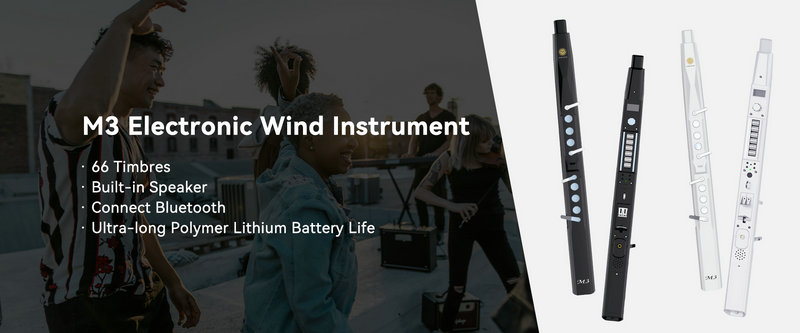
SUNRISE MELODY M3 Electronic Wind Instrument - The best-selling Electronic Wind Instrument
. 66 Timbres
. Built-in Speaker
. Connect Bluetooth
. Ultra-long Polymer Lithium Battery Life