

A one-handed person can practice in the following ways to improve their skills on an electronic wind instrument:
1. Finger Dexterity Exercises:
Practice simple finger exercises to improve dexterity and control. For example, press individual keys or buttons repeatedly with different fingers to build strength and precision.
Try playing scales or simple melodies slowly at first, focusing on accuracy and smoothness. Gradually increase the speed as dexterity improves.
Use exercises that involve alternating fingers or playing patterns that require quick finger movements to enhance finger coordination.
2. Instrument Holding and Stability:
Experiment with different ways of holding the instrument to find the most stable and comfortable position. This may involve using straps, stands, or other supports to keep the instrument in place while playing.
Practice holding the instrument for extended periods to build endurance and muscle memory. Make adjustments as needed to ensure that the instrument remains stable and easy to play.
Consider using adaptive equipment or modifications if available to improve instrument holding and stability.
3. Simplify Music and Focus on Fundamentals:
Start with simple melodies and progress gradually. Avoid complex musical pieces that may be too difficult to play with one hand. Focus on mastering the basics of tone production, rhythm, and pitch.
Analyze music and simplify complex passages into more manageable sections. Play one part at a time and gradually combine them as skills improve.
Concentrate on playing with good tone quality and expression, even if the music is simple. This will help develop musicality and make the playing more enjoyable.
4. Use Technology and Accessories:
Explore the use of technology such as foot pedals, breath controllers, or programmable buttons to expand the capabilities of playing with one hand. These accessories can be programmed to perform certain functions, allowing for more complex musical expressions.
Look for software or apps that can be used in conjunction with the electronic wind instrument to provide additional control options or simplify the playing process.
Experiment with different settings and presets on the instrument to find combinations that are easier to play with one hand.
5. Seek Support and Resources:
Connect with other one-handed musicians or disability support groups to share experiences and learn from others. They may have valuable tips and tricks for playing musical instruments with one hand.
Look for online tutorials, videos, or instructional materials specifically designed for one-handed players. These resources can provide inspiration and guidance on different techniques and approaches.
Consider working with a music teacher or instructor who is experienced in teaching one-handed students. They can provide personalized instruction and help develop a practice plan tailored to individual needs.
6. Practice Regularly and Be Patient:
Consistent practice is key to improving skills. Set aside regular practice time and stick to a schedule. Even short practice sessions on a daily basis can lead to significant progress over time.
Be patient with yourself and don't get discouraged by challenges. Progress may be slower than for two-handed players, but with perseverance and determination, improvement is possible. Celebrate small achievements along the way to stay motivated.
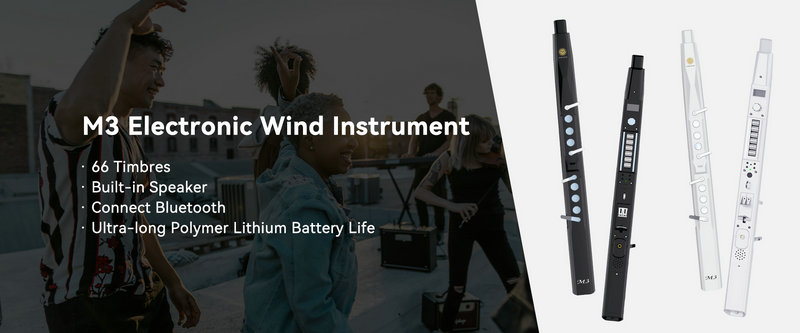
SUNRISE MELODY M3 Electronic Wind Instrument - The best-selling Electronic Wind Instrument
. 66 Timbres
. Built-in Speaker
. Connect Bluetooth
. Ultra-long Polymer Lithium Battery Life