

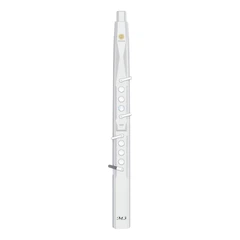

When you play an instrument, the analog signals from the touch pad, breath pressure sensor, and other player controls are converted into a digital data stream, usually using the MIDI message protocol. The data stream is input into some kind of sound synthesizer. The synthesizer outputs an audio signal to an amplifier, in a similar way to other electronic musical instruments.
Some EWIs combine the player controls and the sound synthesizer into a single device that may be battery powered and only requires an audio connection to an external device or headphones. The REMI 3 falls into this category, but it also has a built-in amplifier and speakers for true standalone playback.
Other EWIs consist of two separate parts: a "handpiece" consisting of the player controls, plus a "sound module" containing the synthesizer, power supply, and possibly sound effects and power amplifiers, etc.
If the EWI "handpiece" is equipped with a MIDI-USB adapter/cable, the external "sound module" can be a computer or mobile device running a sound synthesizer application. There are a large number of "VST" synthesizer applications available for download, many of which are freeware.
Like electronic keyboard synthesizers, EWI sound modules or computer VST "synthesizer applications" are capable of generating a wide variety of instrument sounds. In contrast, acoustic instruments produce only one characteristic sound. But synthesizers vary widely in their ability to emulate acoustic instruments. Synthesizers designed specifically for EWI generally have greater expressiveness and control over the nuances inherent to wind instruments.