
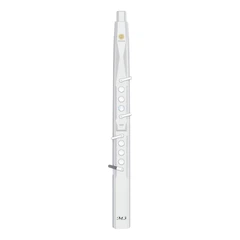


MIDI wind controllers are designed to take advantage of the vast array of existing wind instrument playing techniques while providing the added potential of MIDI control. Nevertheless, while MIDI wind controllers look and behave somewhat like acoustic instruments, they are extremely simplified models of real instruments (non-vibrating reeds, discrete [on/off] keys, etc.). For example, in the WX7 controller, only three types of woodwind instrument gestures are sensed: breath pressure, lip pressure, and fingering configuration. These three types of input are completely independent, sending three discrete 8-bit MIDI data streams.
Acoustic instruments are obviously much more complex by comparison. For example, the reeds of real wind instruments have complex behaviors; many studies have shown that there are complex and subtle nonlinear relationships between different instrument gestures applied to the reed during woodwind instrument sound production. For example, for a given embouchure, the airflow through the reed of a single-reed instrument such as a clarinet or saxophone is related to the pressure on the reed (i.e., the difference between the pressure in the player's mouth and the pressure in the mouthpiece).
In acoustic instruments, the reed actually acts as a pressure-controlled valve, where increased breath pressure tends to blow the valve closed. Therefore, the closing point is a function of the embouchure, since a tight embouchure will cause the reed to close earlier than a loose embouchure for the same pressure differential. In existing controller systems that simulate acoustic instrument interfaces (such as the WX7 or Akai EWI), this type of coupling is not taken into account, since these systems do not include vibrating reeds.
In addition, since wind pipe controllers act as controllers in a two-stage system that traditionally separates control from synthesis, wind pipe controllers inherently do not simulate the physical effects that produce sound (which are also very important feedback for the player). These effects include feedback from the air pressure inside the instrument, resonance, etc. While there is no way to simulate these physical feedback effects in a controller without adding actuators, some of the behavior of acoustic instruments can be simulated by using specialized mappings.


