

Learning how to play electronic wind instruments offers several benefits:
1. Versatility of Sounds
Wide Range of Tonal Options
Electronic wind instruments can produce a vast array of sounds. They can mimic the tones of numerous traditional wind instruments such as saxophones, flutes, clarinets, and trumpets. This allows players to explore different musical styles without having to master multiple traditional instruments. For example, a musician can switch between the sound of a mellow alto saxophone for a jazz piece and a bright trumpet sound for a marching - band - style tune, all on the same electronic wind instrument.
In addition to traditional instrument sounds, they can also generate unique, synthesized sounds that are not possible with acoustic instruments. These synthetic sounds can be used to create futuristic, ambient, or experimental music, opening up new creative possibilities for composers and performers.
2. Ease of Learning for Beginners
Simplified Fingerings and Controls
Compared to some traditional wind instruments, electronic wind instruments often have more straightforward fingering systems. For instance, the keys on an electronic wind instrument may be designed in a more ergonomic and intuitive way, which can be less intimidating for beginners. Additionally, some electronic wind instruments have features like auto - tuning or preset scales, which can help novice players focus on basic playing techniques without getting bogged down by tuning issues or complex scale patterns.
The lack of complex embouchure requirements (the way the lips, tongue, and facial muscles are used to produce sound) in some electronic wind instruments also makes it easier for beginners to produce a sound initially. For example, compared to a traditional flute where precise lip positioning is crucial for proper sound production, an electronic wind instrument may be more forgiving, allowing new players to start making music more quickly.
3. Portability and Convenience
Compact and Lightweight Design
Electronic wind instruments are generally more compact and lighter than many traditional wind instruments. For example, a traditional tuba is large and heavy, making it cumbersome to transport, while an electronic wind instrument can be easily carried in a small case. This portability makes them ideal for musicians who are constantly on the go, such as those who travel for gigs or like to practice in different locations.
They can also be used with headphones, which means players can practice without disturbing others. This is especially useful for students who live in apartments or shared living spaces, or for those who want to practice at odd hours.
4. Integration with Technology
Recording and Editing Capabilities
Most electronic wind instruments can be easily connected to recording devices or computers. This enables players to record their performances with high - quality sound, which can be useful for self - evaluation, sharing music with others, or creating music demos. They can also be integrated with music - editing software, allowing for further manipulation of the recorded sound. For example, a player can add effects like reverb, delay, or distortion to their performance, or even edit out mistakes and improve the overall musical arrangement.
Some electronic wind instruments can also be used in combination with other electronic music devices, such as synthesizers or drum machines. This opens up opportunities for creating complex and layered music compositions, where the electronic wind instrument can play a central role in a multi - track musical production.
5. Adaptability in Different Musical Environments
Volume and Sound Projection Control
Electronic wind instruments offer precise control over volume. This is beneficial in various musical situations. In a small, intimate setting like a coffee shop performance, the player can adjust the volume to a low, ambient level without sacrificing tone quality. In a large concert hall or outdoor event, they can increase the volume to ensure the sound reaches the entire audience.
They are also less affected by environmental factors compared to traditional wind instruments. For example, in a cold or humid environment, traditional wooden wind instruments may be more prone to cracking or having their sound quality affected, while electronic wind instruments can maintain a relatively stable performance.
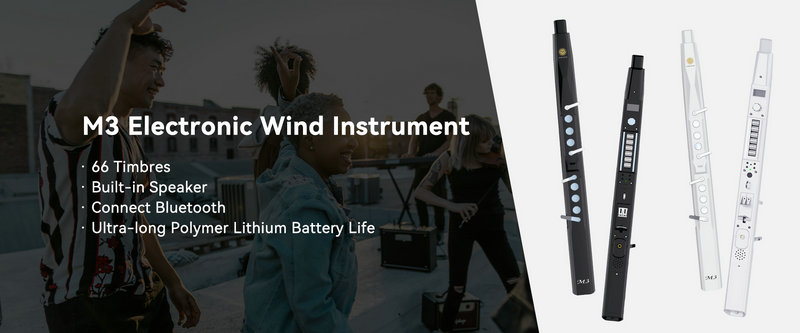
SUNRISE MELODY M3 Electronic Wind Instrument - The best-selling Electronic Wind Instrument
. 66 Timbres
. Built-in Speaker
. Connect Bluetooth
. Ultra-long Polymer Lithium Battery Life