
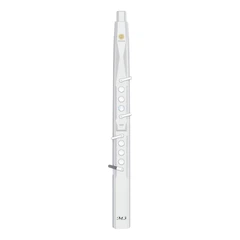


The EWI (Electronic Wind Instrument) saxophone differs from a traditional saxophone in setup and operation in several ways:
Setup:Physical Components:
Traditional Saxophone: A traditional saxophone is a mechanical instrument made of metal (usually brass), with key mechanisms, a reed, a mouthpiece, a neck, and a body. It has a complex system of keys and pads that require precise mechanical adjustments for proper functioning. The reed is a crucial part that vibrates when the player blows air through the mouthpiece, producing the sound24.
EWI Saxophone: The EWI is an electronic device. It typically has a plastic or lightweight metal body with touch-sensitive buttons or pads instead of mechanical keys. It may also have a mouthpiece that is designed to mimic the feel of a traditional saxophone mouthpiece to some extent, but it does not have a reed. Instead, it has sensors that detect the player's breath and finger movements.
Connection to External Devices:
Traditional Saxophone: Generally, a traditional saxophone is a standalone instrument that does not need to be connected to external devices to produce sound. However, in some cases, a microphone may be used to amplify the sound for larger performances or recordings.
EWI Saxophone: The EWI needs to be connected to a power source (such as a battery or an AC adapter) and often to an external sound module, synthesizer, or computer to generate and process the sound. This connection is typically made through MIDI (Musical Instrument Digital Interface) cables or other digital connections, allowing for a wide range of sound manipulation and integration with other electronic musical equipment.
Operation:Sound Production:
Traditional Saxophone: Sound production on a traditional saxophone is based on the player's breath control and the vibration of the reed. The player blows air into the mouthpiece, causing the reed to vibrate, and the vibrating reed then sets the air column inside the saxophone body in motion, producing sound. The player can control the pitch, volume, and tone color by adjusting the strength and direction of their breath, as well as by using different fingerings on the keys24.
EWI Saxophone: The EWI detects the player's breath intensity and finger movements and converts them into digital signals. These signals are then sent to the connected sound module or synthesizer, which generates the sound. The player can manipulate the sound by using various controls on the EWI, such as buttons for changing the sound preset, adjusting the pitch bend, or applying effects like reverb, delay, or distortion.
Playing Techniques and Adaptation:
Traditional Saxophone: Players of traditional saxophones need to develop specific embouchure (the way the lips and mouth are positioned around the mouthpiece) and breathing techniques to produce a good sound. The fingering system is based on the traditional woodwind instrument layout, and players need to practice to achieve dexterity and accuracy in playing different notes and scales. There is a certain physicality and tactile feedback in playing a traditional saxophone, as the keys require a certain amount of pressure to be pressed2.
EWI Saxophone: While the fingering setup on the EWI may be similar to that of a traditional saxophone to some extent, players still need to adapt to the touch-sensitive buttons or pads. The lack of a reed and the different response of the electronic sensors can take some time to get used to. Additionally, the EWI offers more possibilities for experimentation and the use of advanced playing techniques, such as using the breath controller to create continuous glissandos (sliding between notes) or using the MIDI capabilities to interact with other electronic instruments in real-time3.
Sound Range and Flexibility:
Traditional Saxophone: The sound range of a traditional saxophone is limited by the physical characteristics of the instrument. Although different types of saxophones (such as alto, tenor, soprano, etc.) have their own specific ranges, the overall range is relatively fixed. The tone color is also characteristic of the saxophone family, with a warm and rich sound that is suitable for a variety of musical styles2.
EWI Saxophone: The EWI has a potentially much wider sound range, as it can access and manipulate a vast library of sounds stored in the connected sound module or synthesizer. It can mimic the sounds of various instruments, as well as create synthetic and unconventional sounds that are not possible with a traditional saxophone. This gives the player much greater flexibility in creating unique and diverse musical expressions.
SUNRISE MELODY M1 Electronic Wind Instrument
. Revisit the passion and dreams of youth
. M1 electric clarinet wind instrument -- The good news for beginners
. Rich and diverse timbres
. Powerful functions and easy operation
. Perfect after-sales service


