

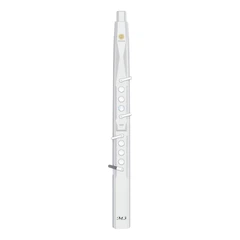

1. **Correct holding posture**
- **Standing posture**: Stand with your feet naturally apart, shoulder-width apart, and the center of gravity of your body evenly distributed on your feet. Gently hold the mouthpiece of the electric wind instrument. At this time, the electric wind instrument should be kept horizontal or slightly tilted downward. The angle should be comfortable and smooth to play. Let your arms hang naturally, bend your elbows slightly, and keep the electric wind instrument at a certain distance from your body to avoid colliding with your body during playing and affecting the pronunciation. Hold the lower part of the electric wind instrument with your right hand, and bend your fingers naturally, mainly to support and stabilize the electric wind instrument.
- **Sitting posture**: Sit on a chair and keep your body straight, don't bend over or hunch your back. The height of the chair should be adjusted to a suitable position so that your feet are flat on the ground and your thighs are parallel to the ground. The posture of holding the mouthpiece and the tilt angle of the electric wind instrument are the same as the standing posture. Similarly, hold the electric wind instrument naturally with both hands to provide stable support.
2. **Basics of fingering**
- **Knowing the keys**: There are a series of keys on the electric wind instrument, which are used to control the pitch. The layout of the keys on different brands and models of electric blowpipes may vary slightly, but generally speaking, they are arranged in a certain scale order. Beginners need to first familiarize themselves with the position and function of the keys on their own electric blowpipes.
- **Basic fingering**: Place the thumb of your right hand on the thumb rest on the back of the blowpipe to balance and stabilize the blowpipe. The fingers of your left hand are mainly responsible for pressing the keys on the top, usually the index finger, middle finger, and ring finger are placed on the corresponding keys in order. When pressing the keys, the fingers should be naturally bent and the fingertips should be used to gently press the keys. Avoid using the fingertips or pressing too hard, so as to ensure the sensitivity and accuracy of the keys. The fingers of your right hand other than the thumb can also assist in pressing some keys located at the bottom of the blowpipe. For specific key functions, please refer to the instruction manual of the blowpipe.
- **Example of fingering practice (taking C as an example)**:
- **Do (1) sound**: In the default state of the blowpipe (no other keys that change the pitch are pressed), the sound played is usually the Do sound of C. At this time, the fingers are basically in a natural position and no keys that change the pitch are pressed.
- **Re (2) sound**: Generally, the Re sound is played by pressing the key corresponding to the left index finger. When pressing the key, make sure that the other fingers are in a stable position. Do not let the electric blowpipe shake or other fingers accidentally touch the key because of pressing a key.
- **Mi (3) sound**: Press the key corresponding to the left middle finger while keeping the other fingers in the correct position to play the Mi sound.
- **Fa (4) sound**: Some electric blowpipes play the Fa sound by pressing the corresponding key with the left ring finger. Also, pay attention to the accuracy and stability of the fingers pressing the key.
- **Sol (5) sound, La (6) sound, Si (7) sound, etc.**: As the scale increases, it may be necessary to press multiple keys at the same time to play the corresponding pitch. This requires beginners to gradually become familiar with the relationship between different key combinations and pitches, and master the accurate fingering through repeated practice.
When you first start learning the holding posture and fingering of the electric blowpipe, don't be too anxious. You should slowly get familiar with and adapt, and form correct muscle memory through repeated practice. This is very important for subsequent learning and playing.
/electronic-wind-instrument/electric-saxophone-ewi.html
